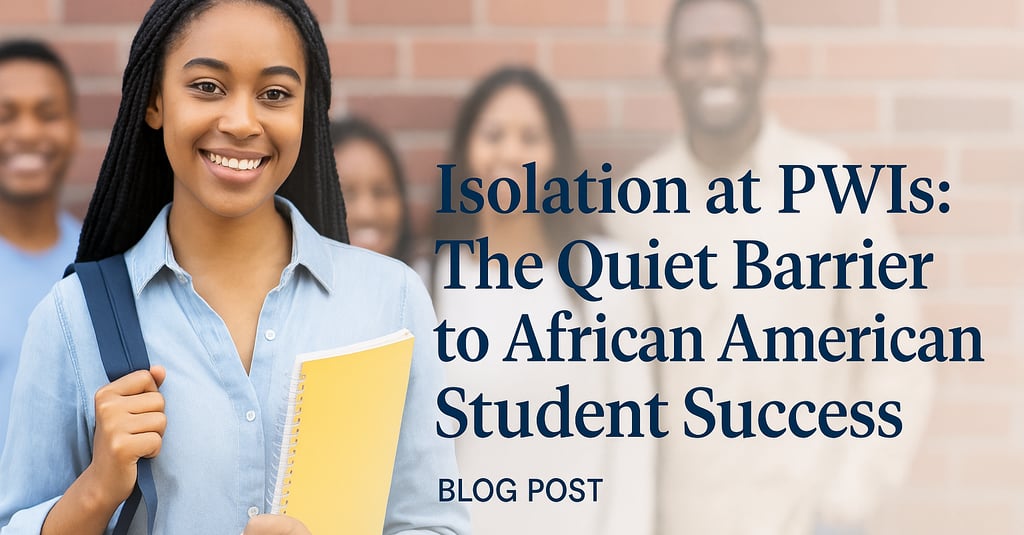
🎓 Isolation at PWIs: The Quiet Barrier to African American Student Success
This blog explores the often-overlooked reality of isolation experienced by African American students at Predominantly White Institutions (PWIs). Written from the perspective of a college dean, it sheds light on how underrepresentation, cultural disconnection, and the dismantling of DEI programs can significantly impact students' mental health, sense of belonging, and ability to persist through graduation. With compassion and clarity, the post calls on schools, parents, and communities to take action — and introduces the Emergency College Toolkit as a practical resource for families preparing their students to thrive on campus, even in the absence of institutional safety nets.
Kris Y. Coleman
4/24/20252 min read

For Predominantly White Institutions (PWIs), the success of African American students isn’t just about access. It’s about belonging.
The Silent Struggle: Isolation on Campus
Walk onto any college campus and you’ll see banners celebrating diversity, equity, and inclusion. But if you listen closely — especially at predominantly white institutions — you’ll also hear another narrative. One less public. One deeply personal.
It’s the story of isolation among African American students.
This isn’t about being homesick or having a quiet weekend. It’s about the systemic absence of representation, the exhaustion of code-switching, and the daily mental load of being one of the only Black students in a classroom, major, or residence hall.
The Emotional and Mental Toll
At PWIs, African American students often carry the invisible weight of:
Navigating racial microaggressions
Having to constantly prove their intelligence or worth
Feeling like they can’t fully show up as themselves
Experiencing cultural detachment from both peers and programming
These challenges aren’t just inconvenient — they’re destabilizing. And over time, they take a toll on students’ mental health and academic performance.
We see this reflected in rising levels of:
Anxiety, depression, and burnout
Campus disengagement
A quiet but dangerous form of withdrawal — from services, community, and ultimately, from school itself
From Isolation to Attrition
Here’s what we must understand:
Isolation isn’t just an emotional burden — it’s a pipeline problem.
When students don’t feel seen or supported:
They’re less likely to seek help early
They’re more likely to leave campus programs or leadership pipelines
And their risk of stopping out or dropping out rises significantly
Matriculation isn’t just about enrolling students.
It’s about sustaining them through the storm.
So What Can Be Done?
The answer isn’t a slogan. It’s a shift. PWIs must:
Provide culturally responsive mental health support
Increase the visibility of Black faculty and staff
Create intentional spaces for Black students to lead and connect
Fill the DEI gaps that have been left behind — with real tools, not just talk
🎒 A Simple But Powerful Start: The Emergency College Toolkit
To help bridge this gap, we’re offering the Emergency College Toolkit — a free resource designed for Black families preparing their students to attend college, especially on campuses without DEI infrastructure.
Inside the Toolkit, you’ll find:
✅ Emergency Campus Wallet Cards
✅ Mental Health Check-In Forms
✅ Crisis Contact Templates
✅ Parent Advocacy Planning Tools
This isn’t just information. It’s preparation.
Whether you're a parent, counselor, school leader, or student support team member — this toolkit can help you give families a plan, not just paperwork.
📥 Download the Free Emergency Toolkit Today
👉 Click here to access the toolkit subscribepage.io/QOJF5C
Let’s stop measuring success by enrollment alone.
Let’s measure it by how well we prepare students to stay, grow, and thrive.
Because no student should feel like they have to do college alone.